


Page 36 - Research and Innovation Pulse
P. 36
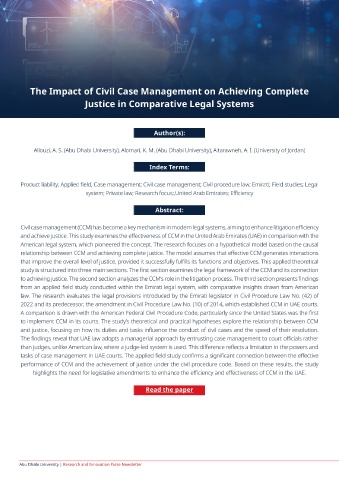
The Impact of Civil Case Management on Achieving Complete                                                           Dense Li1.3Al0.3Ti1.7(PO4)3 (LATP) Solid Electrolytes Synthesized
                               Justice in Comparative Legal Systems                                                             by Taylor–Couette Reactor for All Solid-State Nickel-Rich Lithium-

                                                                                                                                                                       Metal Batteries


                                                       Author(s):

                                                                                                                                                                              Author(s):
             Allouzi, A. S. (Abu Dhabi University), Alomari, K. M. (Abu Dhabi University), Altarawneh, A. I. (University of Jordan)

                                                                                                                                                   Abdelaal, M. M. (Abu Dhabi University), Alkhedher, M. (Abu Dhabi University)
                                                     Index Terms:
                                                                                                                                                                             Index Terms:
        Product liability; Applied field; Case management; Civil case management; Civil procedure law; Emirati; Field studies; Legal
                               system; Private law; Research focus; United Arab Emirates; Efficiency
                                                                                                                               Cathodes; Chemical stability; Ionic conduction in solids; Ionic conductivity; Lithium alloys; Lithium batteries; Lithium
                                                                                                                               compounds; Solid state devices; Solid-State Batteries; Titanium compounds; Advanced material characterization; Advanced
                                                        Abstract:
                                                                                                                               materials; Aluminum titaniums; Battery; Cycling stability; Dense lithium aluminum titania phosphate; Electrochemical
                                                                                                                               storage; Grain-boundaries; Materials characterization; Taylor flow; Titanium phosphate; Grain boundaries; Solid electrolytes
        Civil case management (CCM) has become a key mechanism in modern legal systems, aiming to enhance litigation efficiency
        and achieve justice. This study examines the effectiveness of CCM in the United Arab Emirates (UAE) in comparison with the                                             Abstract:
        American legal system, which pioneered the concept. The research focuses on a hypothetical model based on the causal
        relationship between CCM and achieving complete justice. The model assumes that effective CCM generates interactions   Lithium aluminum titanium phosphate (LATP) is a promising solid electrolyte due to its high ionic conductivity at room
        that improve the overall level of justice, provided it successfully fulfills its functions and objectives. This applied theoretical   temperature, thermal and chemical stability, non-flammability, and compatibility with high-energy cathodes. However,
        study is structured into three main sections. The first section examines the legal framework of the CCM and its connection   LATP faces significant challenges in practical applications, including interfacial contact with electrodes, high grain boundary
        to achieving justice. The second section analyzes the CCM’s role in the litigation process. The third section presents findings   resistance, and dendrite formation. In this study, we develop a novel strategy to synthesize dense LATP using a Taylor–
        from an applied field study conducted within the Emirati legal system, with comparative insights drawn from American   Couette Reactor (TCR) for the first time. This method allows producing dense LATP with high purity from highly mixing
        law. The research evaluates the legal provisions introduced by the Emirati legislator in Civil Procedure Law No. (42) of   and homogenization of reactants. Compared to conventional LATP, dense LATP exhibits higher total ionic conductivity (1 ×
        2022 and its predecessor, the amendment in Civil Procedure Law No. (10) of 2014, which established CCM in UAE courts.   10−4 S cm−1), a wider stability window (4.5 V versus Li/Li+), and longer cycling stability during lithium plating and stripping.
        A comparison is drawn with the American Federal Civil Procedure Code, particularly since the United States was the first   The relative density of dense LATP is higher than that of the conventional variant (96.2% versus 90.3%). Electrochemical
        to implement CCM in its courts. The study’s theoretical and practical hypotheses explore the relationship between CCM   performance testing with a lithium nickel cobalt aluminum oxide (NCA) cathode demonstrates higher capacities, particularly
        and justice, focusing on how its duties and tasks influence the conduct of civil cases and the speed of their resolution.   at high rates. The capacity retention of NCA at 0.5C over 100 cycles using dense LATP is 83%, significantly better than the
        The findings reveal that UAE law adopts a managerial approach by entrusting case management to court officials rather   51% retention observed with conventional LATP. Ex situ XRD analysis after cycling test attributes this retention to the
        than judges, unlike American law, where a judge-led system is used. This difference reflects a limitation in the powers and   improved chemical stability of dense LATP being more stable than the conventional one. This study suggests that LATP is
        tasks of case management in UAE courts. The applied field study confirms a significant connection between the effective                         economically viable and more stable for all-solid-state batteries.
        performance of CCM and the achievement of justice under the civil procedure code. Based on these results, the study
             highlights the need for legislative amendments to enhance the efficiency and effectiveness of CCM in the UAE.
                                                                                                                                                                           Read the paper
                                                    Read the paper


        Abu Dhabi University | Research and Innovation Pulse Newsletter                                                                                                                                                              37

