


Page 29 - Research and Innovation Pulse
P. 29
Mechanistic Insights into the Pharmacological Actions of

 Flavonoids:  A Comprehensive Review


 Author(s):
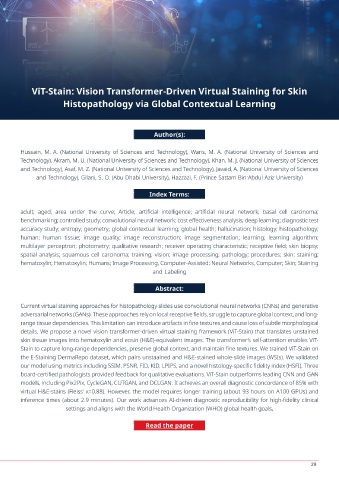
            ViT-Stain: Vision Transformer-Driven Virtual Staining for Skin
 Rasheed, A. (University of Peshawar), Ali, G. (University of Peshawar), Islam, M. R. (Daffodil International University), Rauf,   Histopathology via Global Contextual Learning
 A. (University of Swabi), Ajaj, R. (Abu Dhabi University), Hemeg, H. A. (Taibah University), Iriti, M. (University of Milan /
 National Interuniversity Consortium of Materials Science and Technology)


 Index Terms:                                          Author(s):


 antidiabetic agent; antioxidant; flavonoid; glycosylated protein; liposome; mitogen activated protein kinase; nanoparticle;   Hussain, M. A. (National University of Sciences and Technology), Waris, M. A. (National University of Sciences and
 phosphatidylinositol 3 kinase; protein kinase B; transcription factor Nrf2; antineoplastic activity; apoptosis; autophagy   Technology), Akram, M. U. (National University of Sciences and Technology), Khan, M. J. (National University of Sciences
 (cellular); B lymphocyte; bioavailability; biological activity; cancer inhibition; cardiovascular disease; cell protection; chronic   and Technology), Asaf, M. Z. (National University of Sciences and Technology), Javaid, A. (National University of Sciences
 disease; degenerative disease; diabetes mellitus; drug delivery device; drug delivery system; drug development; drug   and Technology), Gilani, S. O. (Abu Dhabi University), Hazzazi, F. (Prince Sattam Bin Abdul Aziz University)
 mechanism; enhancer region; gene expression; glycosylation; human; hydroxylation; inflammation; molecular docking;
 neuroprotection; nonhuman; oxidative stress; personalized medicine; pharmacokinetics; pharmacology; prevention;   Index Terms:
 prophylaxis; review; signal transduction; structure activity relation; systems pharmacology
        adult; aged; area under the curve; Article; artificial intelligence; artificial neural network; basal cell carcinoma;
 Abstract:  benchmarking; controlled study; convolutional neural network; cost effectiveness analysis; deep learning; diagnostic test
        accuracy study; entropy; geometry; global contextual learning; global health; hallucination; histology; histopathology;

 Flavonoids, a diverse group of polyphenolic chemicals found in plants, have significant attention for their diverse pharmacological   human; human tissue; image quality; image  reconstruction; image segmentation; learning; learning algorithm;
 actions and therapeutic potential. Their ability to target multiple pathways, modulate oxidative stress, and regulate inflammatory   multilayer perceptron; photometry; qualitative research; receiver operating characteristic; receptive field; skin biopsy;
 mediators is crucial in preventing and managing chronic diseases like cancer, cardiovascular disorders, diabetes, and neurodegenerative   spatial analysis; squamous cell carcinoma; training; vision; image processing; pathology; procedures; skin; staining;
 diseases. Flavonoids have multitargeted actions, providing a safer and general therapeutic approach compared to single-targeted   hematoxylin; Hematoxylin; Humans; Image Processing, Computer-Assisted; Neural Networks, Computer; Skin; Staining
 synthetic drugs. This review provides a comprehensive understanding of flavonoids’ biological effects, focusing on their modulation   and Labeling
 of key molecular signaling pathways such as nuclear factor kappa-light-chain-enhancer of activated B cells (NF-κB), mitogen-activated
 protein kinases (MAPK), phosphatidylinositol 3-kinase (PI3 K)/protein kinase B (AKT), nuclear factor erythroid 2-related factor 2 (Nrf2),   Abstract:
 oxidative stress, inflammation, and apoptosis. Their anticancer potential is supported by their ability to induce apoptosis, modulate
 autophagy, and influence gene expression, while their anti-inflammatory and antioxidant properties aid in cytoprotection. Certain   Current virtual staining approaches for histopathology slides use convolutional neural networks (CNNs) and generative
 hydroxylation and glycosylation patterns  enhance their  biological efficacy based on structure-activity connections. The  review   adversarial networks (GANs). These approaches rely on local receptive fields, struggle to capture global context, and long-
 demonstrates the various benefits of these substances, including their hepatoprotective, neuroprotective, anticancer, antidiabetic,   range tissue dependencies. This limitation can introduce artifacts in fine textures and cause loss of subtle morphological
 and cardioprotective properties, based on both experimental and clinical evidence. It discusses the structure–activity relationship   details. We propose a novel vision transformer-driven virtual staining framework (ViT-Stain) that translates unstained
 (SAR) that supports their bioefficacy as well as issues with metabolism, bioavailability, and therapeutic translation. It also provides   skin tissue images into hematoxylin and eosin (H&E)-equivalent images. The transformer’s self-attention enables ViT-
 a comprehensive understanding of flavonoids as potential agents for chronic disease prevention and management, integrating   Stain to capture long-range dependencies, preserve global context, and maintain fine textures. We trained ViT-Stain on
 pharmacological findings with molecular facts. A method was used to identify works published in reputable journals. Every search result   the E-Staining DermaRepo dataset, which pairs unstaained and H&E-stained whole-slide images (WSIs). We validated
 came from PubMed, Scopus, Web of Science, ScienceDirect, Google Scholar, etc The terms flavonoids, pharmacological properties,   our model using metrics including SSIM, PSNR, FID, KID, LPIPS, and a novel histology-specific fidelity index (HSFI). Three
 disease, and mechanism of action were utilized. We selected and investigated research papers, review articles, and original studies   board-certified pathologists provided feedback for qualitative evaluations. ViT-Stain outperforms leading CNN and GAN
 that were published up until 2025. Future research should focus on improving flavonoids’ bioavailability using advanced drug delivery   models, including Pix2Pix, CycleGAN, CUTGAN, and DCLGAN. It achieves an overall diagnostic concordance of 85% with
 methods like conjugates, liposomes, and nanoparticles, with extensive clinical trials needed for validation. Furthermore, the potential   virtual H&E-stains (Fleiss’ κ=0.88). However, the model requires longer training (about 93 hours on A100 GPUs) and
 of flavonoids in therapeutic interventions will be enhanced through the use of computational techniques such as molecular docking,   inference times (about 2.9 minutes). Our work advances AI-driven diagnostic reproducibility for high-fidelity clinical
 network pharmacology, and precision medicine. Future perspectives emphasize the need for advanced drug delivery systems, clinical   settings and aligns with the World Health Organization (WHO) global health goals.
 trials, and molecular docking techniques to enhance their therapeutic efficacy.
                                                    Read the paper
 Read the paper


 Abu Dhabi University | Research and Innovation Pulse Newsletter                                              29

