


Page 33 - Research and Innovation Pulse
P. 33
Task offloading and optimization methods in UAV-enabled mobile   BioOtoFusionNet – A bio-attention & frequency-aware hybrid
 edge computing: A comprehensive survey  network for ear disease classification


 Author(s):                                            Author(s):


 Tesfay, C.H. (School of Telecommunications Engineering, Xidian University), Xiang, Z. (School of Telecommunications Engineering,   Jain, E. (Centre for Research Impact and Outcome, Chitkara University Institute of Engineering and Technology, Chitkara
 Xidian University), Yang, L. (School of Telecommunications Engineering, Xidian University), Mahmood, J. (State Key Laboratory of   University), Kukreja, V. (Centre for Research Impact and Outcome, Chitkara University Institute of Engineering and
 Blockchain and Data Security, School of Cyber Science and Technology, and College of Computer Science and Technology, Zhejiang   Technology, Chitkara University), Kaushik, P. (Centre for Research Impact and Outcome, Chitkara University Institute
 University; Department of Computer Engineering, Faculty of Engineering and Architecture, Istanbul Gelisim University), Ren, M.   of Engineering and Technology, Chitkara University), Ati, M. (Computer Science and Information Technology, College
 (School  of  Telecommunications  Engineering,  Xidian  University),  Zhang,  S.  (School  of  Telecommunications  Engineering,  Xidian   of Engineering, Abu Dhabi University), Hariharan, S. (Department of Computer Science and Engineering, Vel Tech
 University), Das, A.K. (Center for Security, Theory and Algorithmic Research, International Institute of Information Technology;   Rangarajan Dr. Sagunthala R&D Institute of Science and Technology)
 Department  of  Computer  Science  and  Engineering,  College  of  Informatics,  Korea  University),  Chaudhry,  S.A.  (Department  of
 Computer Science and Information Technology, College of Engineering, Abu Dhabi University; Department of Software Engineering,
 Faculty of Engineering and Architecture, Nisantasi University)  Index Terms:


 Index Terms:   Attention Mechanisms; Deep Learning; Dual-Stream Fusion; Ear Disease Classification; Interpretability Metrics; Otoscopic
                                                      Image Analysis
 Antennas; Data mining; Edge computing; Energy efficiency; Energy utilization; Green computing; Surveying; Unmanned aerial vehicles
 (UAV);  Aerial  vehicle;  Communications  channels;  Edge  computing;  Energy-consumption;  Optimisations;  Optimization  method;   Abstract:
 Sensitive application; Task offloading; Unmanned aerial vehicle-enabled mobile edge computing; Optimization

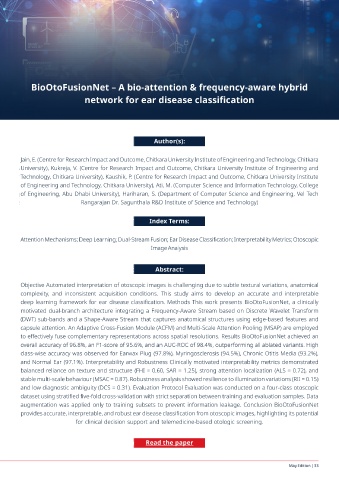
        Objective Automated interpretation of otoscopic images is challenging due to subtle textural variations, anatomical
 Abstract:  complexity,  and  inconsistent  acquisition  conditions.  This  study  aims  to  develop  an  accurate  and  interpretable
        deep learning framework for ear disease classification. Methods This work presents BioOtoFusionNet, a clinically
 The surge in compute-intensive and latency-sensitive applications such as  autonomous  driving and smart cities is  straining   motivated dual-branch architecture integrating a Frequency-Aware Stream based on Discrete Wavelet Transform
 traditional cloud computing. Recent advancements in Mobile Edge Computing (MEC) and the emergence of Beyond 5G (B5G)
 technologies have catalyzed the integration of Unmanned Aerial Vehicles (UAVs), heralding UAV-enabled MEC as a transformative   (DWT) sub-bands and a Shape-Aware Stream that captures anatomical structures using edge-based features and
 paradigm. By utilizing UAVs as flexible aerial edge servers or relays, MEC can bring computational resources closer to end-users,   capsule attention. An Adaptive Cross-Fusion Module (ACFM) and Multi-Scale Attention Pooling (MSAP) are employed
 thereby reducing latency and enhancing service quality. Despite their advantages, challenges remain regarding task offloading,   to effectively fuse complementary representations across spatial resolutions. Results BioOtoFusionNet achieved an
 specifically,  determining  when,  how,  and  whether  to  transfer  computational  tasks  from  user  devices  to  UAV-MEC  servers  for   overall accuracy of 96.8%, an F1-score of 95.6%, and an AUC-ROC of 98.4%, outperforming all ablated variants. High
 remote processing. UAV constraints, offloading strategies, communication channels, and energy consumption complicate the task   class-wise accuracy was observed for Earwax Plug (97.8%), Myringosclerosis (94.5%), Chronic Otitis Media (93.2%),
 offloading process. Therefore, sophisticated optimization strategies are essential to balance latency, energy consumption, task   and Normal Ear (97.1%). Interpretability and Robustness Clinically motivated interpretability metrics demonstrated
 completion rates, and overall system efficiency. This survey paper focuses on task offloading strategies and optimization methods   balanced reliance on texture and structure (FHI = 0.60, SAR = 1.25), strong attention localization (ALS = 0.72), and
 for UAV-enabled MEC networks. We discuss potential UAV-enabled MEC architectures, focusing on the interactions between UAVs   stable multi-scale behaviour (MSAC = 0.87). Robustness analysis showed resilience to illumination variations (RII = 0.15)
 operating within the MEC framework and ground users, as well as communication channel access. We present task offloading   and low diagnostic ambiguity (DCS = 0.31). Evaluation Protocol Evaluation was conducted on a four-class otoscopic
 methods and optimization techniques. Although UAV-enabled MEC holds great promise, it still faces challenges that need to   dataset using stratified five-fold cross-validation with strict separation between training and evaluation samples. Data
 be addressed to support a broader range of applications. We highlight research issues and future opportunities, divided into   augmentation was applied only to training subsets to prevent information leakage. Conclusion BioOtoFusionNet
 three levels based on the real-world deployment of UAV-enabled MEC, moving from those most critical to those important for   provides accurate, interpretable, and robust ear disease classification from otoscopic images, highlighting its potential
 optimization and scale.
                            for clinical decision support and telemedicine-based otologic screening.
 Read the paper
                                                    Read the paper


 Abu Dhabi University | Research and Innovation Pulse Newsletter                                      May Edition | 33

